
What Effective Leaders Do in Their First 90 Days

A roadmap for success
by Peter Fay
Stepping into a new leadership role is a moment that carries both opportunity and responsibility. It also carries risk and remains a key challenge addressed within our coaching practice.
The first 90 days are often where people begin to form their view of you—how you think, how you listen, and how you make decisions. In a nutshell, people decide quickly what type of leader they think you are, their initial perception of whether you are trustworthy and whether the forecast looks positive or gloomy moving forward.
Our natural urge is to jump into action, problem solve, rescue failing teams or goals and prove ourselves quickly. Sometimes that’s what the space requires. But in practice, the strongest starts need to be steady, considered, and grounded in understanding the context you’re entered.
To put this into perspective, I once had a coaching client who thought they had “aced” the first 90 days based on what their new boss wanted, only to find it was not aligned with their team or stakeholders. The rework was long and painful.
The 90-Day Roadmap: Working in phases that make sense
The 90-Day Roadmap is helpful because it reflects how leadership actually works in real environments—you learn first, then align, then act.
Days 1–30: Take the time to understand
The first month is about building a clear, accurate picture.
This usually means:
Sitting down with people across the business
Listening to how work really gets done (not just how it’s described)
Noticing team and power dynamics, pressure points, and strengths
A simple but effective addition here is using a Stakeholder Grid (read more below). It helps you think deliberately about who you need to hear from—not just the obvious voices, but also those who are deeply affected by decisions.
When people feel they’ve genuinely been listened to, that tends to stay with them. Trust is cultivated. This is equally the stage where we need to be careful not to be critical of how work gets done, as that too will stay with them.
Days 31–60: Make sense of what you’re hearing
By the second month, patterns begin to emerge.
You now have a clearer view of the organisation and where attention is needed. This is where your earlier listening efforts and stakeholder mapping begin to connect.
At this stage, it helps to bring in more structured inputs. People around us can influence well to the wrong outputs. Our own biases or mindtraps need to be challenged through structured decision making.
You might:
Review performance data or team metrics to validate what you are hearing
Use AI tools or simple analysis to spot patterns across feedback and conversations
Gather broader input through short surveys or pulse checks
Sharing what you are seeing, with the right people, allows others to confirm or challenge your view. This builds alignment and ensures you are moving forward with a shared understanding.
Days 61–90: Move forward with clarity
By the third month, you’re in a position to act.
This might involve:
Setting clearer expectations
Addressing issues that have been lingering
Adjusting how teams works together and the team culture - team norms, behaviours, working practices
Because you’ve taken the time to understand the context, these decisions tend to land differently - because they are not based on gut feel but instead are grounded in evidence ~ they therefore considered rather than reactive.

Being intentional with relationships
One of the most useful shifts a leader can make early on is to be deliberate about relationships.
A Stakeholder Grid helps you map three important groups:
Those who have influence over decisions
Those who are impacted by decisions
Those you will directly impact in your role
This exercise often brings a few things into focus. You may notice individuals who have strong influence without formal authority. You may also identify people who are significantly affected by change but are not always consulted. This is especially important in building inclusive workplaces.
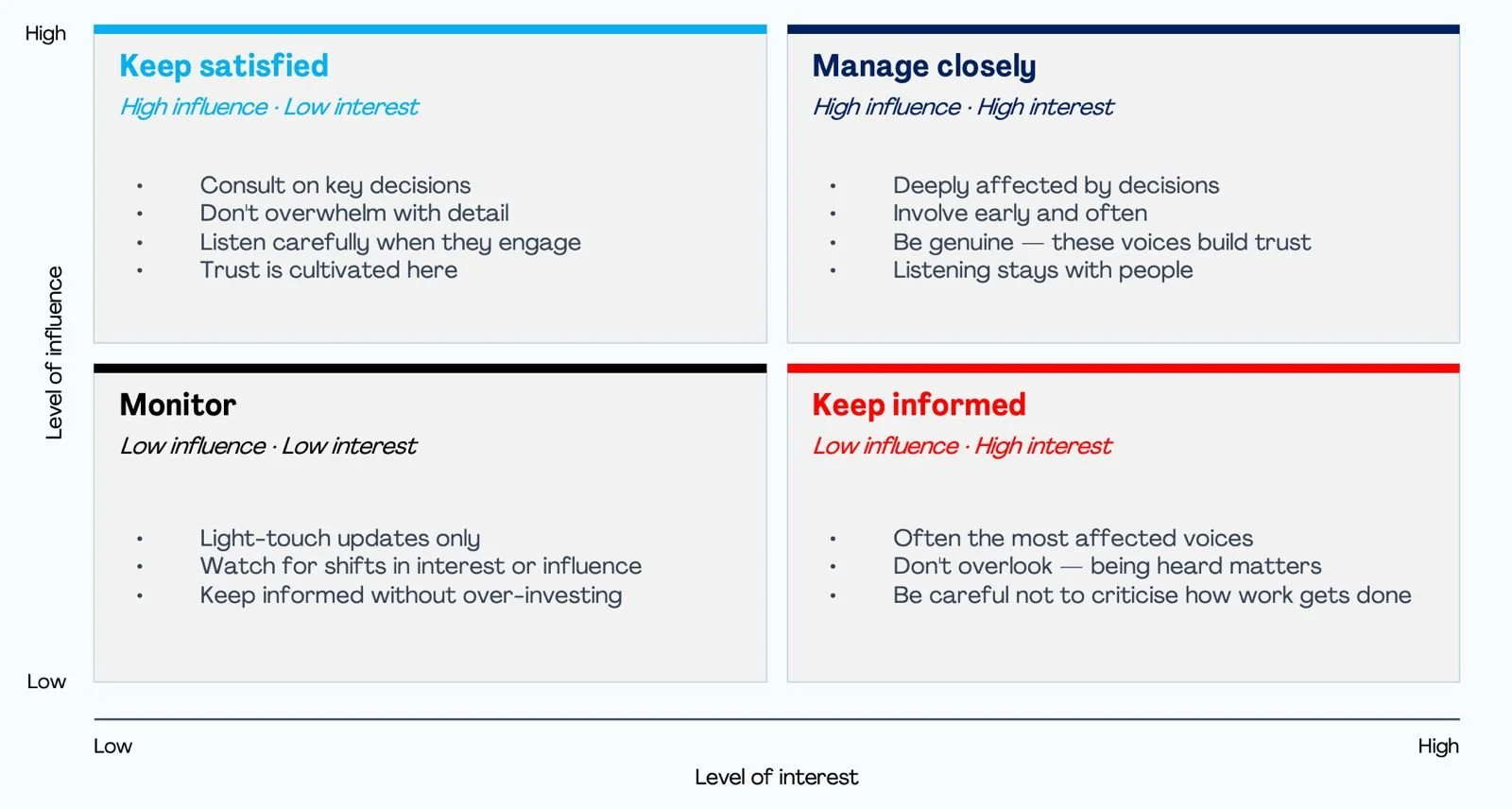
Adapted from Mendelows matrix
Spending time with these groups early helps reduce misunderstandings later, and it shows that you are paying attention to how the organisation really works, not just how it is structured.
Once you know who your stakeholders are, the next step is to understand how they work.
Personality frameworks can support this in a practical way:
The Hogan Personality Inventory helps you understand how individuals are likely to perform in their role and how they may respond under pressure
The DiSC model helps you recognise different communication styles and adjust how you engage
CliftonStrengths highlights where people are most likely to contribute consistently strong work
MBTI helps build awareness of different preferences and ways of thinking
These tools are most useful when they inform how you engage with people day to day. They help you adjust your approach so conversations are clearer and more effective.
When you understand both the structure around you and the people within it, relationships tend to build more quickly.
Our team are accredited in a range of Personality Assessments including Hogan Leadership Assessments. Find out more:
The Start, Stop, Continue Framework: A balanced way to make changes
When it comes to deciding what to change, structure helps.
The Start, Stop, Continue Framework keeps things balanced:
Stop – What is getting in the way?
Start – What’s missing that would make a difference?
Continue – What is already working well?
Amplify – Where could we get more value from existing strengths?
Transfer – What could be owned differently across the team?
What’s useful here is that it doesn’t assume everything is broken. In most teams, there’s already a lot that’s worth keeping—and building on.
What people really notice
Frameworks help, but behaviour and action is what people remember.
In those early months, people are quietly asking:
Do they really listen?
Do they respect what’s come before?
Are they clear about what matters?
Do their actions line up with what they say?
It’s often the small, consistent actions that shape these answers.
Over time, that creates something valuable—clarity, trust, and a sense of direction that people can get behind.
And this is what will carry forward long after the first 90 days.
